When discussing traditional Chinese architecture, attention often turns to imperial palaces, official compounds, temples, and celebrated vernacular forms such as Anhui residences or Fujian tulou. Yet across the vast landscapes of northern China, another group of buildings developed quietly over centuries. These are the ordinary civil residences distributed along the Huang He Basin and hidden among valleys, loess terraces, and mountain settlements.
These residences rarely entered formal architectural records, but they preserved practical construction wisdom and reveal how local communities adapted to climate, terrain, and available materials. Especially in many historic mountain city settlements, these houses formed a distinctive architectural system that differs from the timber-dominant tradition usually presented in Chinese architectural history.
Residences Along the Huang He Basin
The Huang He Basin, or Yellow River Basin, is widely regarded as one of the birthplaces of ancient Chinese civilization. Early agricultural communities emerged here thousands of years ago, gradually developing settlement patterns, social organizations, and construction traditions that later influenced large parts of East Asia.
Unlike the humid regions south of the Yangtze River, northern territories developed under relatively dry conditions, colder winters, and a landscape shaped by plateaus and river valleys. The extensive Loess Plateau in particular offered abundant earth but limited high-quality timber resources.
As population increased and settlements expanded, local builders explored construction methods that reduced dependence on long timber beams. Over generations, these experiments created a unique residential tradition that spread across villages and historical urban settlements.
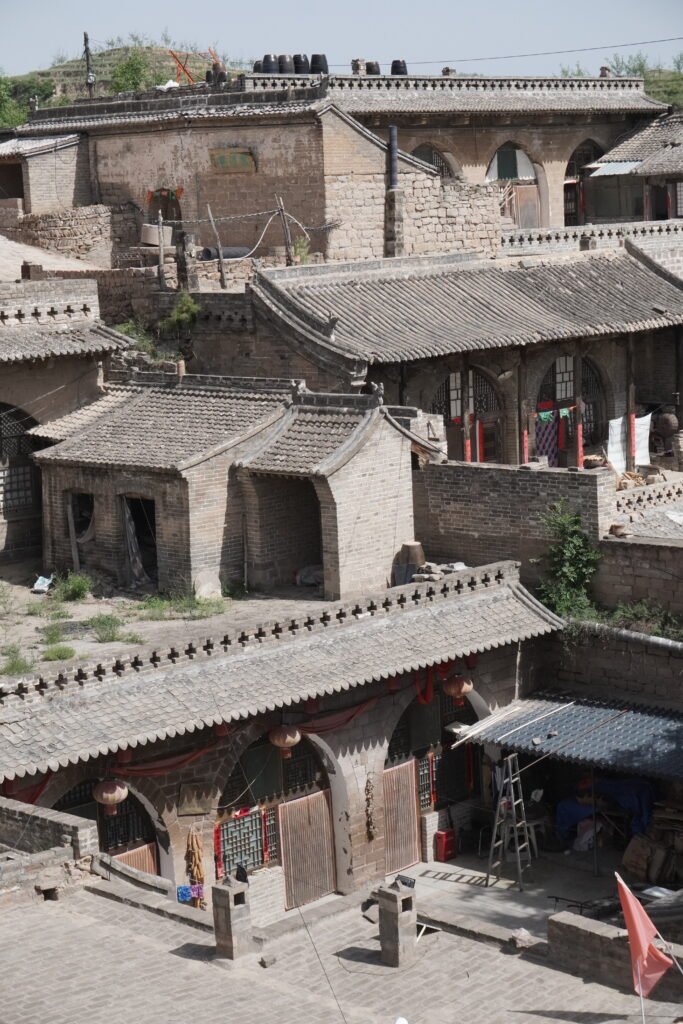
Many of these overlooked civil residences appeared in areas where terrain restricted expansion. Houses climbed slopes and followed contour lines, eventually shaping dense residential districts that resembled a layered mountain city landscape.
For readers interested in broader settlement forms, related discussions can connect naturally with articles such as How Chinese Ancient City Walls Excite an Architect and Top 4 Classic Types of Chinese Traditional House on archinatour.com.
Hybrid Structure of the Residences Along the Huang He Basin
Brick and Timber Working Together
One remarkable characteristic of these northern houses is their hybrid structural logic.
Conventional descriptions of traditional Chinese architecture often emphasize complete wooden pillar-beam systems. However, in large areas of the Huang He Basin, builders combined masonry and timber into an integrated structure.
Brick walls carried enclosure and partial loads, while timber frameworks supported roofs and upper rooms. This method reduced wood consumption and improved thermal performance.
The Wide Use of Brick Arches on the Loess Plateau
The most distinctive feature was the extensive use of brick arches.
On the Loess Plateau, builders mastered vault and arch construction using locally produced grey bricks. Instead of spanning spaces with long wooden members, they created curved masonry chambers capable of supporting heavy loads.
This technique likely evolved from cave dwelling traditions and gradually transformed into above-ground architecture. The resulting spaces preserved stable indoor temperatures throughout the year.
Unlike monumental masonry structures elsewhere, these arches remained practical and modest. They became a defining element of regional civil residences, especially in settlements embedded into hillsides.
The structural idea also demonstrates that traditional Chinese architecture was more diverse than the standard image of exposed timber frames.
Readers interested in roof and structural evolution may also explore What Is Post and Lintel Construction in Chinese Architecture and How a Carpenter Constructs the Frame of Traditional Chinese House.
Typical 2-Layer Residence
The Lower Arch-Cave Layer
Among the most representative forms was the two-layer residence.
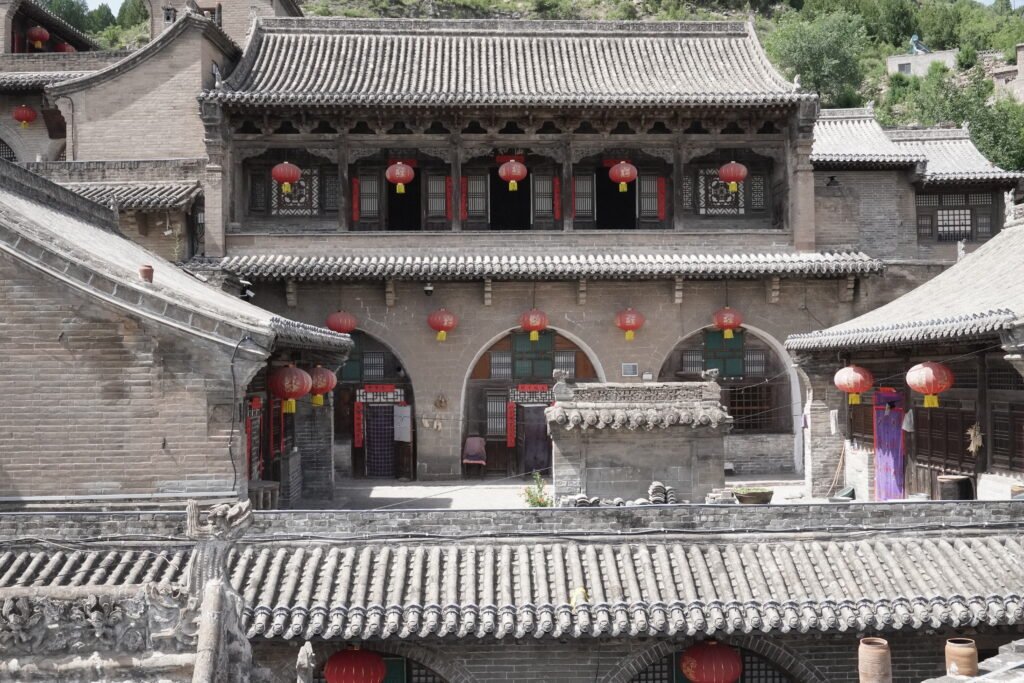
The ground level usually consisted of three or five adjacent arch-caves arranged horizontally. These vaulted spaces served as storage rooms, kitchens, workshops, or winter living areas.
The thick masonry walls and earth covering provided excellent insulation and structural stability.
The arrangement reflected practical planning principles rather than ceremonial hierarchy.
The Upper Wooden Living Floor
Above the arch-cave base stood a conventional timber building.
Builders placed wooden columns, beams, and roof structures directly over the masonry platform. The upper floor received better daylight and ventilation, making it suitable for daily family life.
This vertical combination created an efficient use of limited land resources and adapted naturally to steep terrain.
From a distance, entire villages built in this manner appear stacked against the landscape, creating an architectural profile associated with historic mountain city environments in northern China.
These residences demonstrate how Chinese builders freely combined construction technologies instead of following a single canonical system.
A Courtyard Surrounded by Individual Buildings
Courtyard as the Organizational Core
Although materials and structures varied, spatial organization remained deeply Chinese.
Most compounds centered on a courtyard.
Instead of one continuous building block, several independent structures enclosed an open central space. Family activities, seasonal work, ceremonies, and circulation concentrated here.
This arrangement balanced privacy and collective life.

Flexible Growth Through Individual Buildings
Another advantage of this layout was flexibility.
Families could expand gradually by adding new rooms or replacing individual buildings without rebuilding the entire compound.
In mountain settlements, courtyards adapted to irregular topography. Walls bent with the land, and elevation differences produced layered spatial experiences.
Compared with formal urban compounds, these vernacular civil residences expressed stronger responses to geography and everyday life.
For comparison with mainstream residential traditions, readers may also refer to The Wooden Art of Traditional Chinese Homes: A Tale of Two Regions.
Conclusions
The unrecorded residential traditions of the Huang He Basin reveal an overlooked chapter of Chinese architectural history.
These civil residences do not rely solely on timber frames or monumental decoration. Instead, they combine brick arches, wooden structures, terraced planning, and courtyard organization into a practical architectural language.
Across northern China, especially in settlements shaped like a mountain city, generations of anonymous builders created buildings that responded directly to climate, terrain, and available resources.
Although these houses rarely appeared in historical manuals or official records, they preserve valuable evidence of how ordinary people constructed their living environment. Studying them expands the understanding of traditional Chinese architecture beyond imperial standards and highlights the diversity hidden within China’s built heritage.