
Xi Tang is one of the most representative traditional Chinese towns in the Yangtze River Delta. Located in Jiashan County, Zhejiang Province, this well-preserved water village has been shaped for more than a thousand years by canals, stone bridges, and timber houses. Unlike many historic towns that have been overwhelmed by modern traffic, Xi Tang remains remarkably pedestrian-friendly, allowing visitors to experience the rhythm of daily life in a traditional Chinese town almost exactly as it was centuries ago.
As a classic Jiangnan water village, Xi Tang is not only a scenic destination but also a living textbook of Chinese traditional architecture. Its spatial organization, residential forms, bridges, corridors, and waterfront streets embody architectural wisdom developed to adapt to water-rich environments. For readers interested in Chinese architecture and urban history, Xi Tang offers a rare opportunity to observe how buildings, waterways, and human movement merge into a coherent whole.
Where Xi Tang Fits in Chinese Water Village Culture
Xi Tang belongs to the Jiangnan region, an area south of the Yangtze River known for dense river networks, mild climate, and prosperous mercantile culture. Famous water villages such as Zhouzhuang, Tongli, and Wuzhen share similar characteristics, but Xi Tang stands out for its intact pedestrian scale and residential continuity.
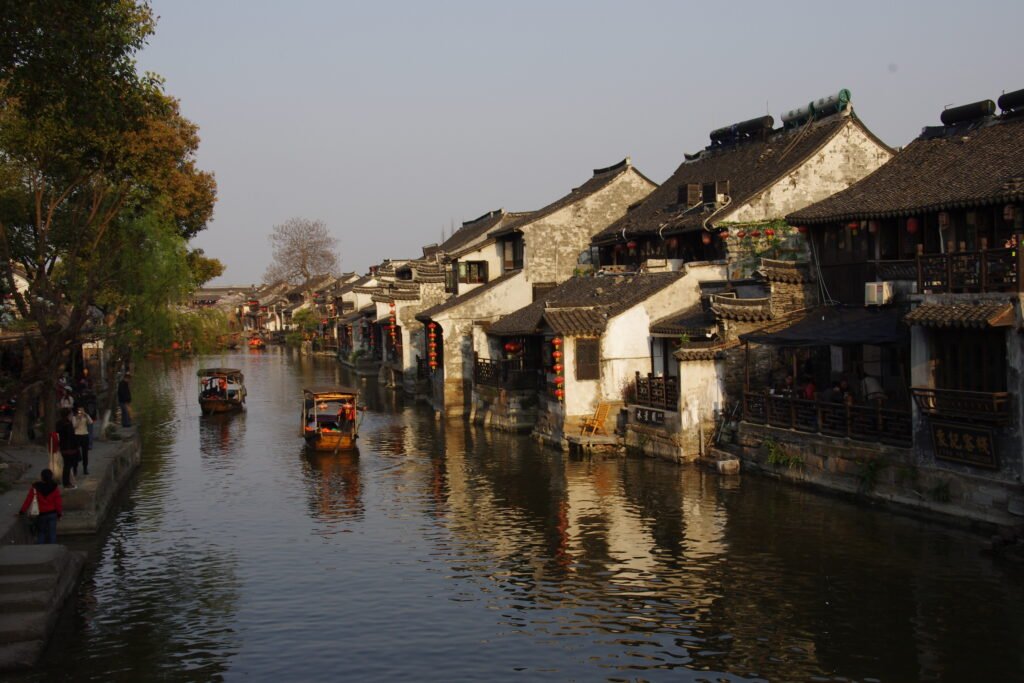
In traditional Chinese town planning, waterways often replaced streets as the primary transportation system. Boats functioned as vehicles, and houses opened directly onto canals. In Xi Tang, this pattern remains clearly visible: narrow alleys parallel the water, stone bridges connect neighborhoods, and buildings form continuous street walls along the canals.
From an architectural perspective, Xi Tang represents a mature form of water village urbanism, where private residences, commercial spaces, and public circulation are seamlessly integrated.
Urban Layout of Xi Tang as a Pedestrian Town
Waterways as the Core Urban Framework
The canals of Xi Tang are not decorative elements but structural components of the town. They define blocks, determine building orientation, and regulate movement. Most streets follow the water, creating linear pedestrian routes that are naturally shaded by overhanging eaves.
Because boats once served as the main means of transportation, there was little need for wide roads. This historical condition explains why Xi Tang remains so walkable today. Pedestrians can move comfortably through the town without interference from vehicles, making Xi Tang a rare example of a traditional Chinese town designed entirely at human scale.
Stone Bridges and Slow Movement
Xi Tang has over a hundred stone bridges of various sizes, most built during the Ming and Qing dynasties. These bridges are typically single-arch structures made of granite or bluestone. Architecturally, they serve both functional and symbolic roles.
The gentle slopes of the bridges naturally slow movement, encouraging pauses and social interaction. In traditional Chinese architecture, such subtle control of movement is a recurring theme, also seen in courtyard houses and garden design. In Xi Tang, the entire town becomes a continuous architectural sequence experienced on foot.
Traditional Residential Architecture in Xi Tang
Timber Framework and Courtyard Houses
The residential buildings in Xi Tang are primarily timber-framed structures, following the post-and-lintel construction system common in Chinese traditional architecture. Wooden columns support beams and roof structures, while walls function mainly as enclosures rather than load-bearing elements.
Many houses follow a narrow, deep plan with small courtyards or light wells. This layout maximizes land use while ensuring ventilation and daylight, an architectural response well suited to the humid climate of Zhejiang Province. Similar structural principles can be found in other traditional Chinese houses, as discussed in articles such as Top 4 Classic Types of Chinese Traditional House on archinatour.com.
White Walls and Black Tiles
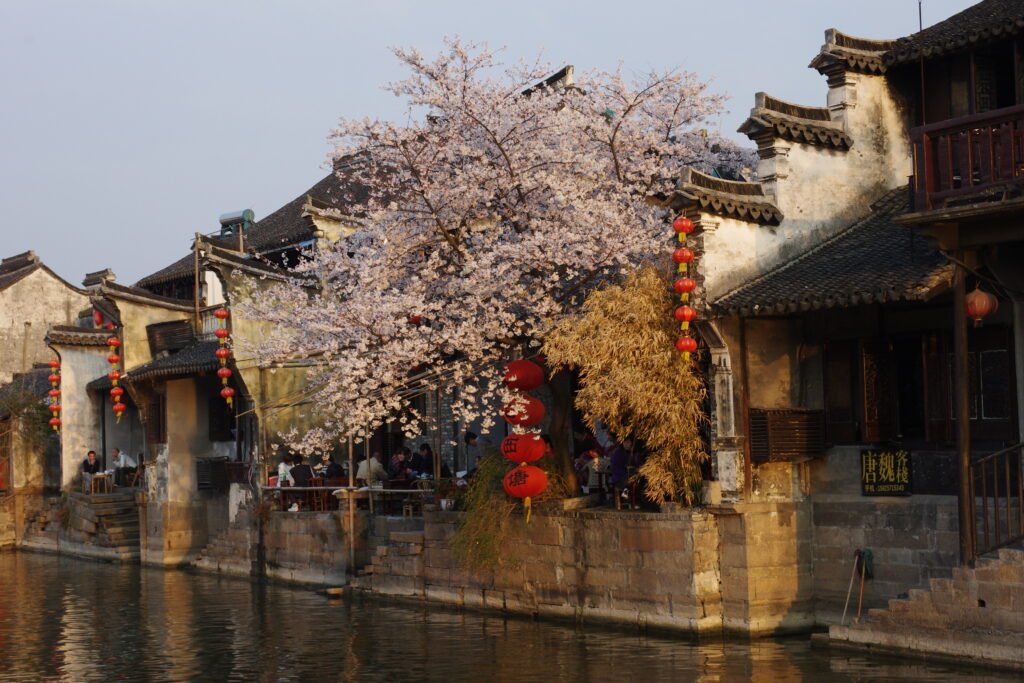
The visual identity of Xi Tang is defined by whitewashed walls and dark gray or black roof tiles. This restrained color palette is typical of Jiangnan traditional Chinese towns, emphasizing harmony with the water and surrounding landscape.
Roofs are usually simple gabled forms, often classified as Ying Shan roofs in Chinese architectural terminology. While less prestigious than Wu Dian roofs, these roofs are highly practical, allowing rainwater to drain efficiently into canals and courtyards.
Houses Facing Water and Street
A distinctive feature of Xi Tang is the dual orientation of houses. Many residences open toward both the canal and the street, reflecting a mixed-use lifestyle. The waterside façade often includes stone steps for boat access, while the street side accommodates shops or living spaces.
This spatial arrangement demonstrates how Chinese traditional architecture adapts to economic and social needs without altering its structural logic.
Covered Corridors: Architecture for Pedestrians
Langpeng: The Iconic Covered Walkways
One of the most memorable architectural features of Xi Tang is its extensive network of covered corridors, locally known as langpeng. These roofed walkways run along the canals, protecting pedestrians from rain and summer sun.
From an architectural standpoint, langpeng represent an extension of private buildings into public space. Timber columns support tiled roofs, creating a semi-outdoor environment that blurs the boundary between house and street.
Social and Climatic Functions
The covered corridors are not merely shelters. Historically, they served as social spaces where residents chatted, traded goods, and observed daily life along the water. In this sense, Xi Tang demonstrates how traditional Chinese town design integrates architecture with social behavior.
For modern visitors, these corridors reinforce Xi Tang’s reputation as a pedestrian-friendly town, offering comfort and continuity rarely found in contemporary urban environments.
Architectural Details Reflecting Daily Life
Doors, Windows, and Shopfronts
Walking through Xi Tang, one encounters wooden doors with carved panels, lattice windows, and foldable shopfronts. These elements are modest in scale but rich in craftsmanship.
The architectural language here is practical rather than monumental, reflecting the town’s mercantile background. Unlike imperial architecture or religious complexes, Xi Tang’s buildings express the aesthetics of everyday life within a water village economy.
Stone Paving and Drainage
The streets of Xi Tang are paved with long stone slabs laid in subtle patterns. Their slight curvature helps channel rainwater toward the canals, demonstrating traditional knowledge of drainage and maintenance.
This attention to detail reinforces the idea that Xi Tang is not a frozen museum but a functional town shaped by centuries of use.
Xi Tang and the Broader Context of Chinese Traditional Architecture
Comparison with Other Traditional Towns
Compared with northern Chinese towns, where city walls and wide streets dominate, Xi Tang reflects a completely different architectural logic. The absence of defensive walls and the dominance of water-based circulation highlight regional diversity within Chinese traditional architecture.
Readers interested in how geography influences architecture may find parallels between Xi Tang and other water-based settlements discussed on archinatour.com, such as articles on traditional Chinese houses and urban forms.
Lessons for Modern Urban Design
Xi Tang offers valuable insights for contemporary urban planning. Its pedestrian-oriented layout, mixed-use buildings, and climate-responsive architecture align closely with modern sustainability principles.
By studying Xi Tang as a traditional Chinese town, architects and planners can rediscover strategies for human-scale design that modern cities often lack.
Preserving Xi Tang as a Living Water Village
Preservation efforts in Xi Tang focus on maintaining original materials, construction techniques, and spatial patterns. Timber structures are repaired rather than replaced, and canals are regularly maintained to support both tourism and local life.
The challenge lies in balancing heritage conservation with economic development. So far, Xi Tang has managed to retain its architectural authenticity while welcoming visitors, making it one of the most successful examples of water village preservation in China.
Conclusion: Why Xi Tang Matters
Xi Tang is more than a picturesque destination. It is a complete traditional Chinese town shaped by water, architecture, and pedestrian movement. Every bridge, corridor, and house reflects principles deeply rooted in Chinese architectural tradition.
For travelers, Xi Tang offers an immersive walking experience through history. For architecture enthusiasts, it provides a clear and accessible example of how Chinese traditional architecture functions at the urban scale. And for anyone interested in sustainable, human-centered design, this water village in Zhejiang Province remains a timeless source of inspiration.
As part of China’s rich architectural heritage, Xi Tang continues to demonstrate how towns built for people, not vehicles, can remain vibrant for centuries.

A really good blog and me back again.
I appreciate it.