In traditional Chinese architecture, the façade of a wooden building is more than a decorative surface—it reflects the structural logic and ritual hierarchy behind the entire construction. Among the essential components forming this façade is the Lan’e (阑额), often translated as the wooden lintel. It connects pillars horizontally, joins Dougong vertically, and visually defines the rhythm of bays in a timber framework.
This article introduces the architectural role of the Lan’e, following descriptions from the Yingzao Fashi (《营造法式》), the 12th-century building manual that standardized Song-dynasty construction methods.
Lan’e (阑额) in the Yingzao Fashi
The Yingzao Fashi defines the Lan’e with the line:
“造阑额之制,长随间广,两头至柱芯,入柱卯减厚之半。”
Translated literally, this means:
“In making the Lan’e, its length follows the width of the bay; both ends reach the pillar’s centerline and are inserted into the pillar mortises, reduced in thickness by half.”
This concise instruction reveals the careful precision behind the lintel’s design. The Lan’e is not simply a horizontal beam—it is proportioned to match the jian (bay) width, extending precisely from the center of one pillar to the next. At both ends, it fits into mortises cut into the pillars, half-thickness deep, ensuring tight structural integration without excessive bulk.
In the Yingzao Fashi, the Lan’e belongs to the façade system (qiankuan zhi zhi 前檐之制), which forms the visible front of halls and pavilions. It is positioned below the Dougong bracket set and above the architrave panels or pingban fang. The Lan’e thus marks the transition between the ornamental and the structural layers of a building’s front elevation.
For more context about the Yingzao Fashi, see “Post and Lintel Construction in Chinese Architecture”.
Lan’e (阑额) as the Lintel Between Pillars Horizontally
Defining the façade rhythm
Horizontally, the Lan’e functions as a lintel, connecting two adjacent pillars within a single bay. Each Lan’e defines the top boundary of the open space between pillars, visually dividing the façade into a sequence of rectangular frames. In this sense, it performs a role similar to the lintel in Western architecture, but within a different wooden construction logic.
While Western lintels often bear the weight of the wall above, the Chinese Lan’e primarily stabilizes the spacing between pillars and supports decorative elements like pingban (flat boards) or hua’e (carved fascia boards). Structurally, it helps control horizontal alignment and maintains the orthogonality of the wooden frame.
Aesthetic and symbolic values
In large halls such as those found in Buddhist temples or palatial architecture, the Lan’e is often decorated with painted or carved motifs—cloud patterns, dragons, or floral scrolls—echoing the building’s ritual function. This blend of structure and ornament exemplifies the Chinese architectural idea that “decoration grows from construction.”
For examples of how wooden frames shape façades, see “How a Carpenter Constructs the Frame of a Traditional Chinese House”.
Lan’e (阑额) as the Joint of Dougong and Pillars Vertically
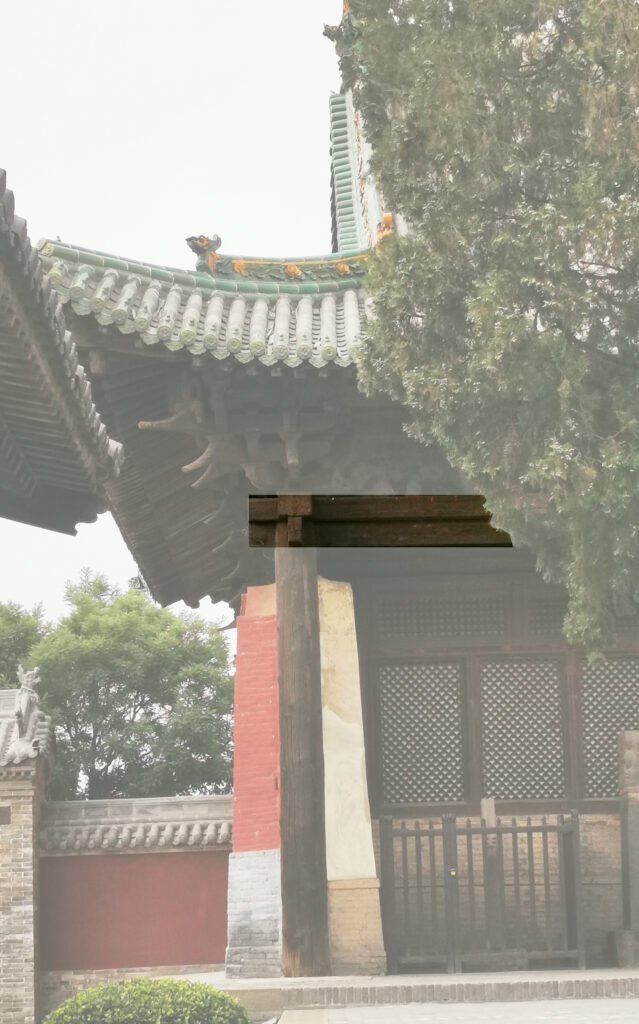
Vertically, the Lan’e occupies a crucial position between the pillar (zhu) below and the Dougong (斗拱) bracket set above. It serves as the intermediary that transfers loads and unites these two major components of Chinese timber architecture.
Structural connection
The Lan’e’s top surface often supports the base block (dou), the first element of the Dougong. Its mortised connection with the pillar ensures that vertical loads pass smoothly through the lintel to the ground. Because the Lan’e’s ends are cut half-thickness into the pillars, it avoids creating weak points while maintaining firm engagement. This design reflects the Chinese mastery of mortise-and-tenon joints, a topic explored in “The Wooden Art of Traditional Chinese Homes: A Tale of Two Regions”.
Transition of spatial layers
Architecturally, the Lan’e also defines the visual boundary between the supporting frame and the overhanging roof. Its placement emphasizes the layering that characterizes Chinese façades—from the solid ground to the rhythmic pillars, from the Lan’e lintel to the rising bracket sets, and finally to the majestic roof above. This vertical sequence embodies balance and order, key principles in Chinese building aesthetics.
Conclusions
The Lan’e (阑额), though often overlooked, is a fundamental component of the wooden lintel system in traditional Chinese architecture. Its precise proportions, as recorded in the Yingzao Fashi, show the rigorous standards of ancient carpenters. Horizontally, it binds pillars and defines the rhythm of the façade; vertically, it connects the Dougong with the pillar, transmitting forces and organizing the elevation.
The study of the Lan’e deepens our understanding of the post-and-lintel logic underlying Chinese timber structures. Beyond its technical role, it reflects a refined architectural philosophy where structure, ornament, and ritual meaning are perfectly unified.
To explore related elements of traditional wooden construction, visit other guides on archinatour.com, such as “Wu Dian Roof – The Highest Ranking of Chinese Roof” and “What Is Ying Shan Roof in Chinese Architecture”.